From Clay Seals to E-Stamps: The Indian History of Agreements
Published July 2026 · 12 min read
Every rental agreement, every business contract, every e-stamp certificate we generate today is the modern-day descendant of a promise someone once made to someone else, and then found a way to prove it. That single problem — how do I make you believe I will keep my word tomorrow, next year, or after I’m gone — is arguably the oldest engineering problem in human civilisation. Older than the wheel, arguably. This is the story of how India solved it, broke it, and re-solved it, across roughly 5,000 years.
Why Mankind Needed Agreements in the First Place
For most of human prehistory, trust wasn’t a legal question — it was a survival one. Small hunter-gatherer bands of 30 to 150 people (the “Dunbar’s number” ceiling anthropologists still cite) could run entirely on reputation. Everyone knew everyone. If you cheated the group on a hunt, you didn’t need a contract to punish you — exile or ostracism did the job, and exile from the band was often a death sentence.
The trouble started with surplus. Once humans domesticated grain and animals around 10,000–8,000 BCE — the Neolithic Revolution — societies stopped being small and mobile and became large, settled, and specialised. A farmer now had grain he wasn’t going to eat this week. A herder had milk he wanted to trade for tools. A stranger three villages away had something you needed, but you’d probably never see him again after the transaction, so reputation alone couldn’t discipline him if he cheated you.
This is the exact moment “the agreement” as a technology was born: a way to make a promise binding between strangers, enforceable later, and provable to a third party (an elder, a king, a court) who wasn’t present when the deal was struck. Every subsequent invention in this history — seals, witnesses, written scripts, notarisation, stamp duty, and now Aadhaar eSign — is really just a better answer to that same 10,000-year-old question.
South Asia happens to have one of the best-documented, longest-running case studies of this evolution anywhere in the world, because Indian civilisation never really had a “dark age” that erased the record. It runs almost unbroken from the Indus Valley to the download button on your phone.
The First Indian “Signatures”: Indus Valley Seals (c. 2600–1900 BCE)
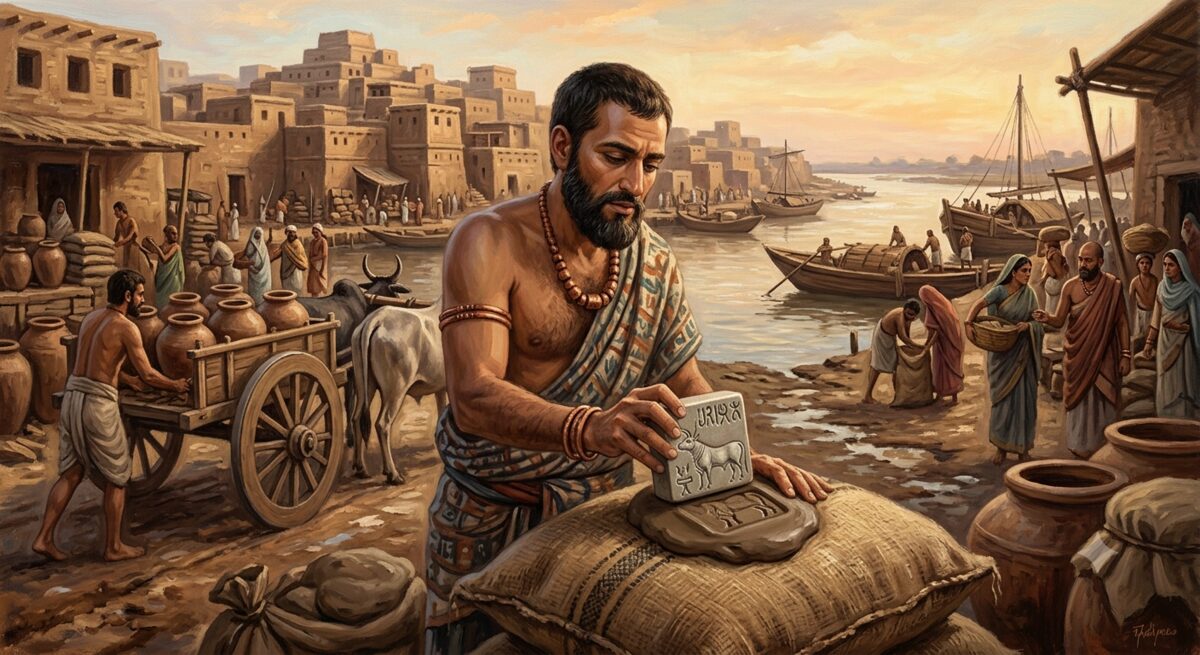
Long before anyone in the subcontinent could write a sentence we can fully translate, Harappan and Mohenjo-daro merchants were pressing carved steatite seals into wet clay to mark bales of goods travelling by cart and boat, sometimes as far as Mesopotamia. Over 4,000 of these seals have been recovered. Each carries a unique animal motif (the famous “unicorn” bull is the most common) and a short line of undeciphered script.
Historians broadly agree these weren’t decoration — they were commercial identity marks, the Bronze Age equivalent of a company stamp or a wax seal on a letter: this shipment belongs to, or has been inspected/approved by, this trader. It’s the earliest physical evidence in Indian history of a person using a fixed, repeatable mark to stand in for their word when they weren’t there to say it themselves. That is, structurally, exactly what a stamp does today.
The Vedic and Dharmashastra Era: When a Spoken Word Was the Contract
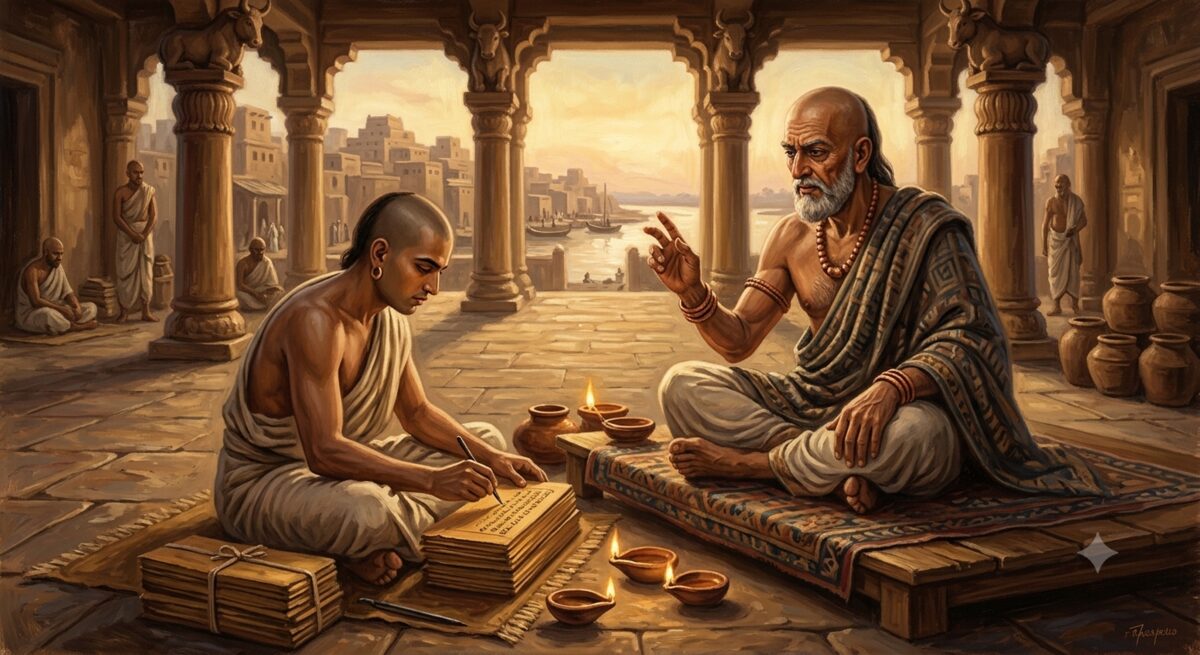
In the Vedic period, agreements were largely oral, sealed by satya vachan — the spoken truth — witnessed by fire (Agni), water, or an assembly of elders (the sabha or samiti). Breaking your word wasn’t a civil matter; it was a moral and cosmic one, a breach of Rta (cosmic order) and later dharma. This is why so many of India’s most quoted stories about honesty are, structurally, stories about someone refusing to break an agreement even at devastating personal cost.
By the time of the Dharmashastras (roughly 200 BCE–200 CE) and texts like the Yajnavalkya Smriti, India had moved from pure orality to a hybrid system. These texts lay out detailed rules for rna (debt) and loan agreements: the need for witnesses, the rate of interest permissible by caste, what happens if a debtor dies, and how a written bond (rnapatra) could be produced as evidence in a dispute before the king’s court. This is India’s earliest documented “contract law.”
Kautilya’s Arthashastra: India’s First Contract Code (c. 3rd Century BCE)
If the Vedic age gave India the idea of an agreement, Chanakya’s Arthashastra gave it the system. Book III of the Arthashastra reads, in places, like a strikingly modern statute. It specifies:
- That transactions above a certain value made without witnesses could be legally challenged.
- Rules for loan documents, mortgages, sale deeds, partnership agreements, and even employment contracts for artisans and labourers.
- Procedures for dispute resolution when a written agreement (lekhya) conflicted with oral testimony.
- State-appointed officials whose job was essentially proto-notarisation — verifying that a document was genuine before it could be relied upon in court.
This is remarkable: a functioning, state-administered contract and evidentiary framework, in India, roughly two thousand years before the British “invented” stamp paper on the subcontinent. It’s a useful corrective to the common assumption that formal contract law is a colonial import — the infrastructure of e-stamping is colonial-and-digital, but the legal concept is thoroughly indigenous and ancient.
Ashoka’s Edicts: The Agreement Carved So It Could Never Be Broken
A century after Kautilya, Emperor Ashoka took the concept of the binding written word to a civilisational scale. His edicts — carved into rock faces and sandstone pillars across the subcontinent between 268–232 BCE — were, functionally, a public agreement between a ruler and his subjects: a promise of non-violence, religious tolerance, welfare works, and just governance, made permanent and unforgeable in stone precisely so it could not be quietly walked back. It’s the earliest known example in Indian history of “putting it in writing” as a deliberate act of political accountability — the ancient equivalent of publishing a policy so it can be held against you later.
The Great Mythological Agreements — and the Wars They Caused When Broken
Indian mythology doesn’t just illustrate morals in the abstract; a striking number of its central plots are literally contract disputes. These stories remain the most emotionally resonant part of this 5,000-year history.
Raja Harishchandra and Sage Vishwamitra
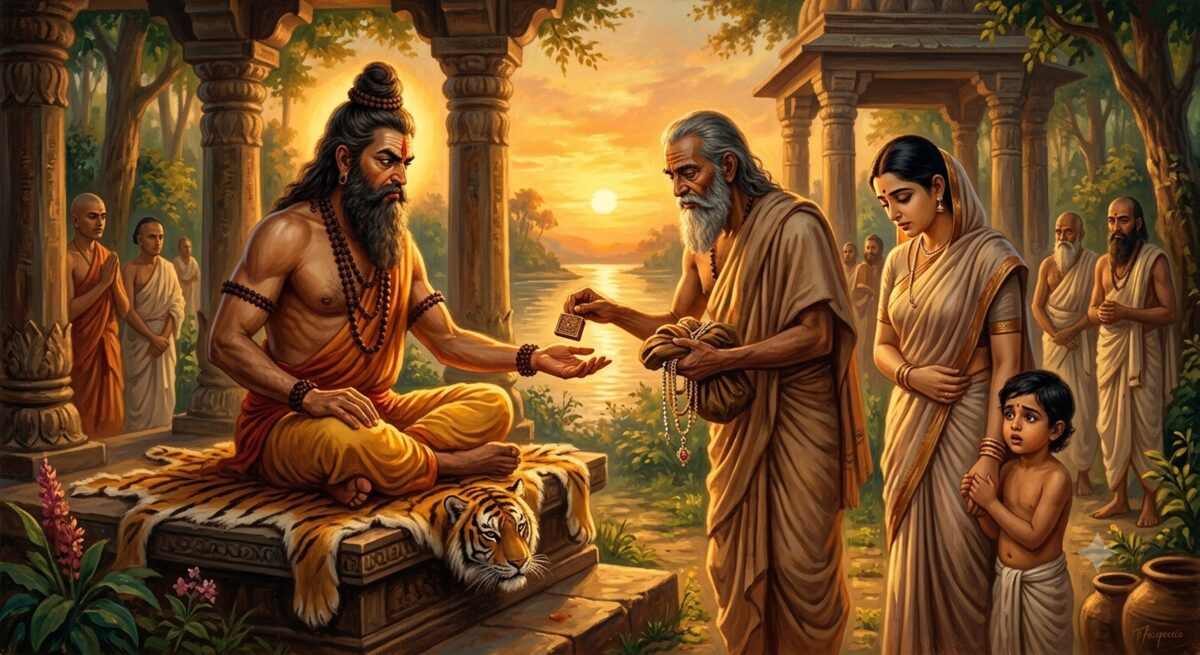
The Puranic story of Harishchandra is, at its core, a story about specific performance of a promise. Harishchandra vows to give Vishwamitra whatever he asks. Vishwamitra demands his entire kingdom, then a further dakshina (fee) that Harishchandra cannot pay after giving away everything — so he sells his wife, his son, and finally himself into slavery rather than break his word. It is still invoked in Indian culture today as the ultimate parable of satya — truth as a binding, unbreakable agreement, regardless of the cost of performance. In modern contract language, Harishchandra is a story about a party who honours an agreement even when it becomes commercially catastrophic to do so.
The Mahabharata’s Dice Game — The Most Consequential Broken Agreement in Indian Literature
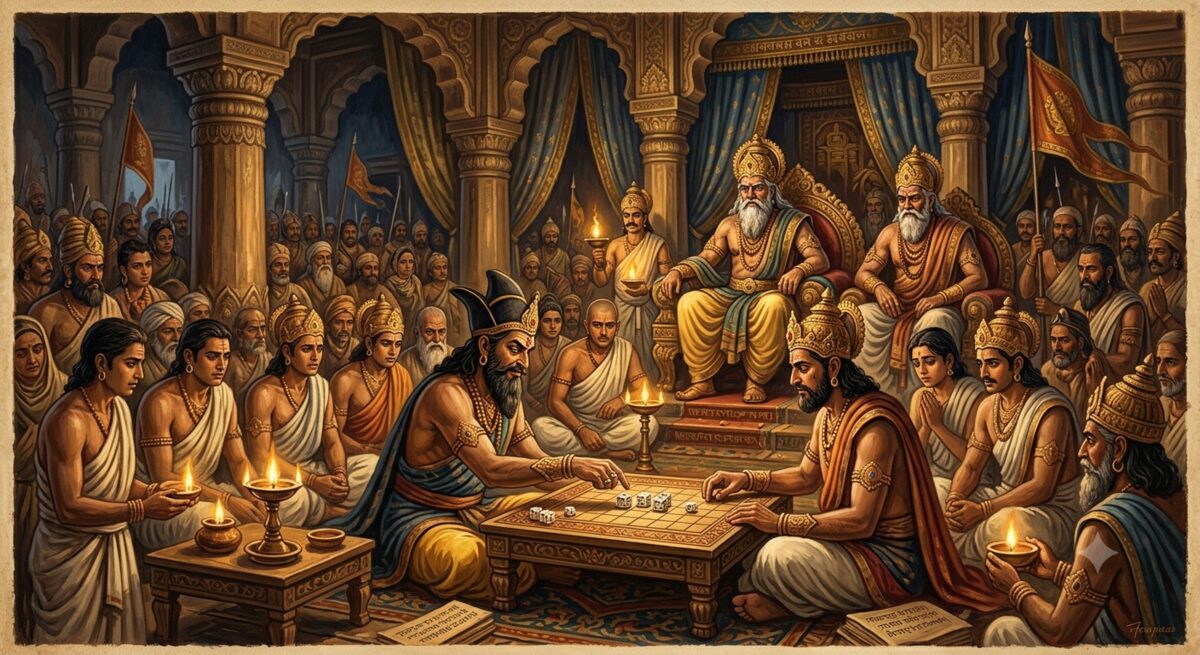
Yudhishthira’s game of dice with Shakuni is, structurally, a rigged contract: an “agreement” entered into under duress and deception, in which Yudhishthira stakes his kingdom, his brothers, himself, and finally Draupadi. When Duryodhana and Dushasana then try to publicly disrobe Draupadi in the assembly hall, they are also violating the deeper unwritten agreement of protection owed to any woman brought into a royal court — an agreement the elders present (Bhishma, Drona) controversially fail to enforce, despite recognising it has been broken. This single breached “agreement” is the direct cause of the Kurukshetra war.
Later, Krishna’s peace mission to Hastinapura — asking Duryodhana to honour the exile agreement and return just five villages to the Pandavas — is itself the last attempt to prevent war through the enforcement of an existing pact, and its failure is what makes war inevitable.
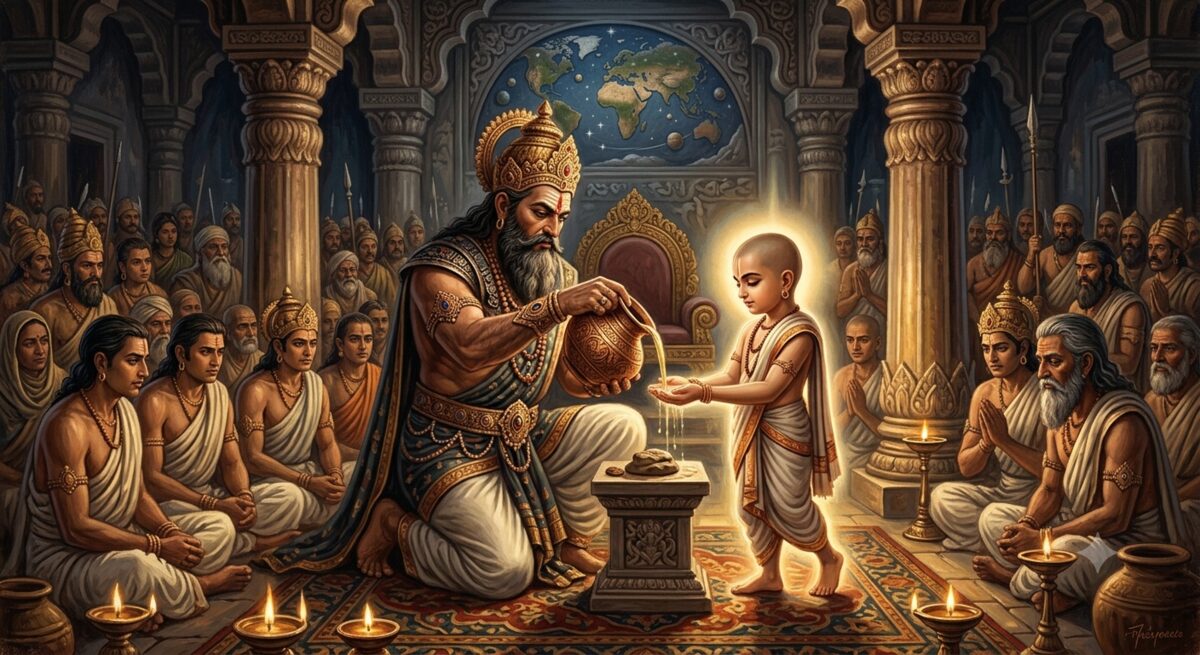
King Bali and Vamana
In the Vamana avatar story, the asura king Bali agrees to grant Vishnu’s dwarf-Brahmin avatar “three paces of land.” Vamana then expands to cosmic size and claims the earth, sky, and underworld in those three paces. Bali, though he has been deceived through a technicality, still honours the agreement completely — offering his own head for the third step rather than reneging, because a promise made before witnesses (with water poured over the hand, an ancient Indian ritual of contractual sealing called sankalpa) could not be broken. It’s one of Indian mythology’s clearest depictions of the ritual sealing of an agreement — the poured water is functionally a signature.
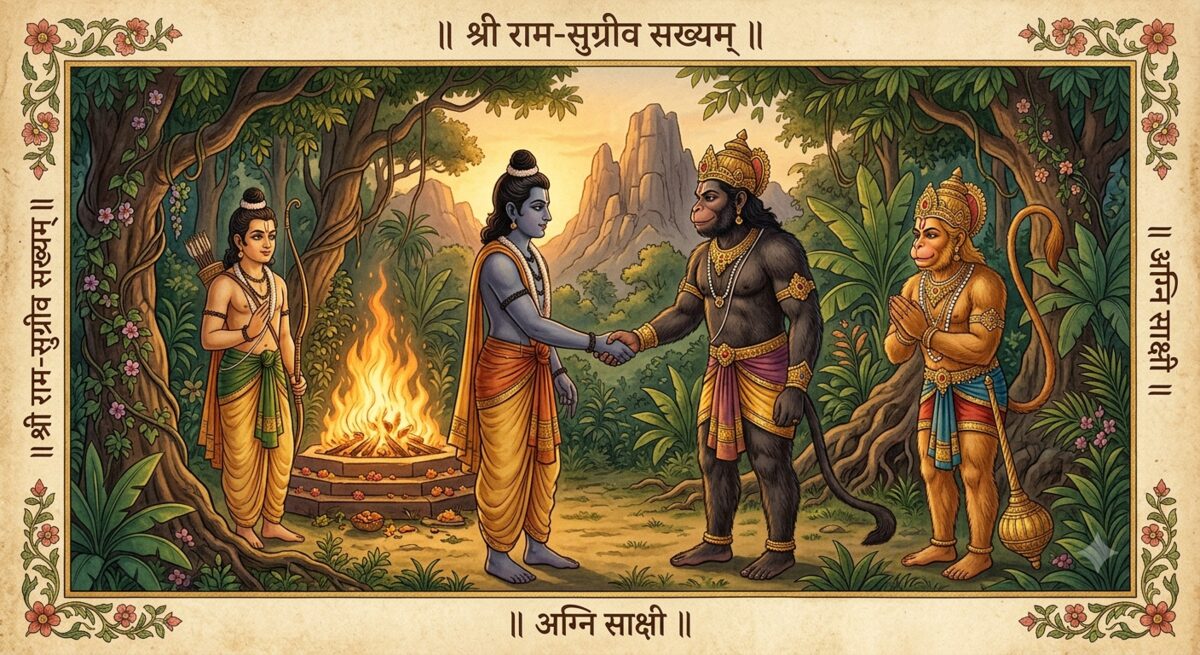
Sugriva and Rama’s Treaty of Alliance
In the Ramayana, Rama and Sugriva enter an explicit mutual-aid pact around a sacred fire — Rama will help Sugriva reclaim his throne from Bali, and Sugriva will help Rama find Sita. This is one of the earliest depicted bilateral treaties in Indian literature, complete with performance obligations on both sides, and a subplot (Sugriva’s initial delay in honouring his half of the bargain, until Lakshmana intervenes) about the classic real-world problem of a party who wins their side of the deal early and is then slow to deliver on the rest.
Medieval India: Seals of Empire and the Birth of the Notarised Document
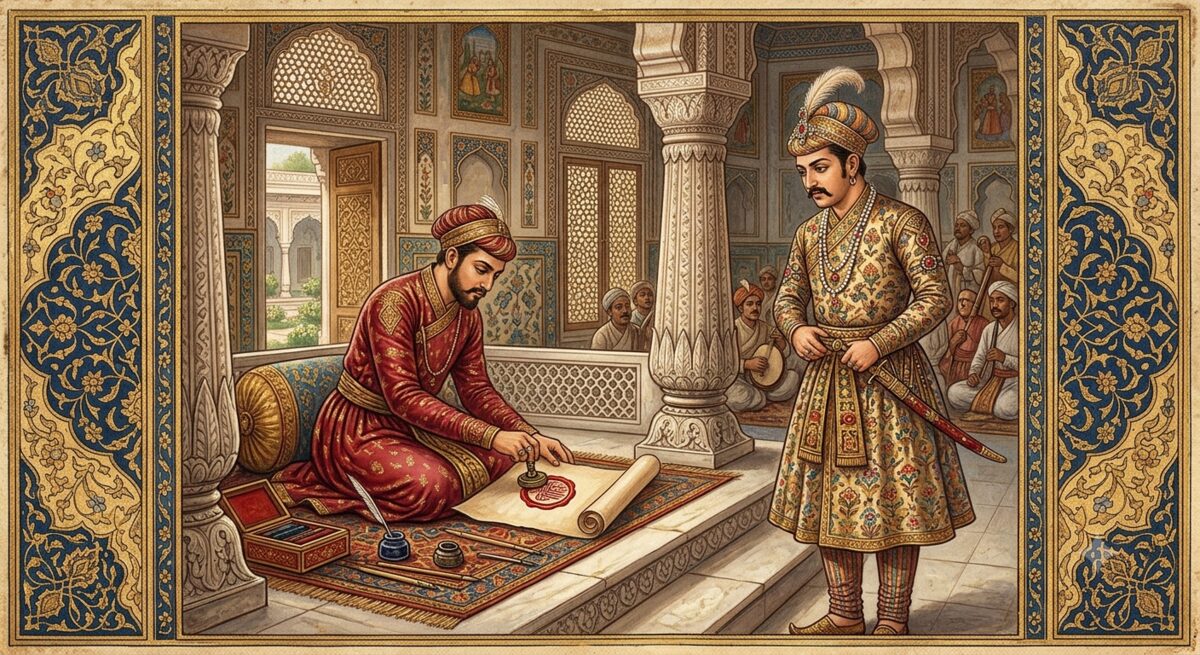
Through the Gupta, Chola, and Vijayanagara periods, land grants (tamra-patra, copper-plate charters) issued by kings to temples, brahmins, or officials became the gold standard of a legally durable agreement — engraved on copper plates, sealed with the royal insignia, and often stored for centuries in temple archives, some of which survive today and are still used by historians (and occasionally courts) to settle disputes.
Under the Delhi Sultanate and later the Mughals, the farman (an imperial decree) and sanad (a grant or charter) became the dominant instruments of formal agreement, each authenticated with the emperor’s mohr (seal) or tughra (calligraphic monogram), often affixed with wax or ink. Merchant guilds of the period — Marwari, Chettiar, and Gujarati trading networks — ran a parallel, informal-but-rigorously-enforced system of hundis (bills of exchange) and partnership deeds, backed not by government stamping but by community reputation networks so strong that a hundi could be honoured thousands of kilometres away, sight unseen, purely on the strength of the signatures and seals it carried.
In many ways, these merchant networks were centuries ahead of the state in building trust infrastructure for agreements between strangers.
Where “Stamp Duty” as We Know It Actually Comes From
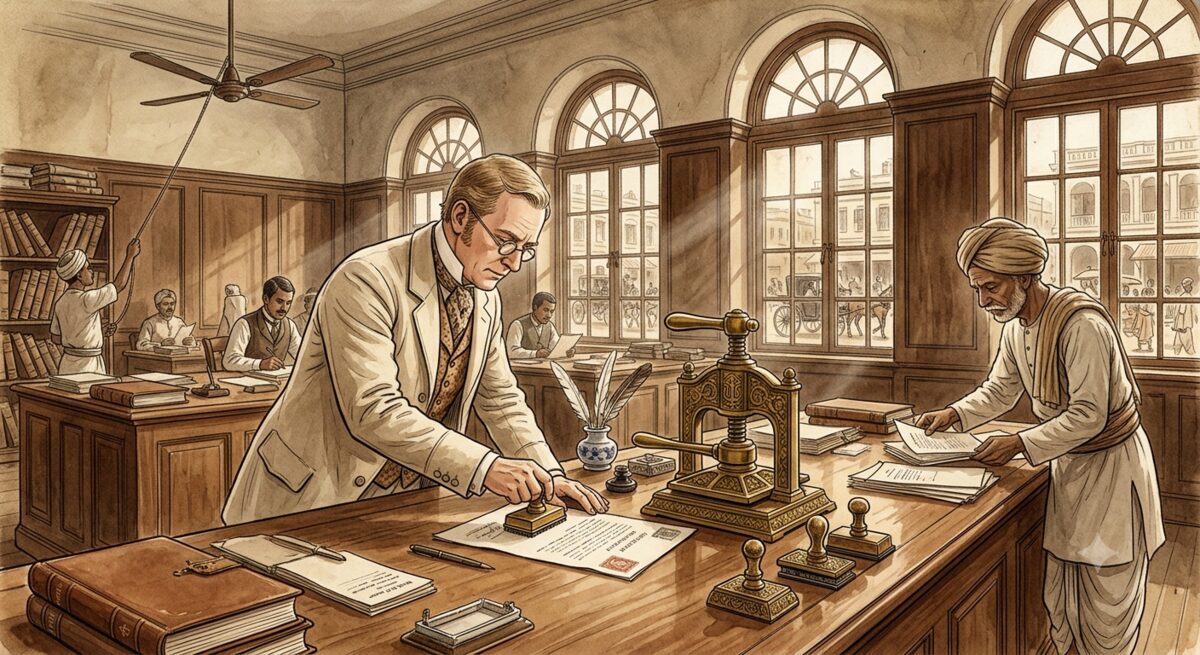
Here’s a detail that usually surprises readers: stamp duty is not a British or Indian invention at all. It was devised in the Netherlands in 1624, after the Dutch government ran a public competition to find a new form of taxation, and settled on charging a fee for an official stamp on legal and commercial paper. England adopted the model roughly seventy years later, in 1694, initially as a wartime revenue measure (to help fund the war against France), taxing vellum, parchment, and paper.
The East India Company brought the mechanism to India through Regulation VI of 1797, levying stamp duty on legal papers and documents across Bengal, Bihar, Orissa, and Benares — the first formal stamp-duty law on Indian soil. Over the next century, Bengal, Bombay, and Madras presidencies each ran their own patchwork of stamp regulations, until the British Crown (which had taken direct control of India after 1857) consolidated everything into the Indian Stamp Act, 1899, enacted by the Imperial Legislative Assembly on 27 January 1899 and effective from 1 July 1899.
That single 1899 Act — amended repeatedly since, and now administered state-by-state — is still, remarkably, the legal backbone of stamp duty in India today, including on Karnataka rental agreements e-stamped through SHCIL.
When Agreements Were Broken: The Darkest Chapter
If honouring an agreement is the moral high point of much of this history, breaking one is where some of the most consequential and painful chapters of Indian history sit.
The Battle of Plassey, 1757
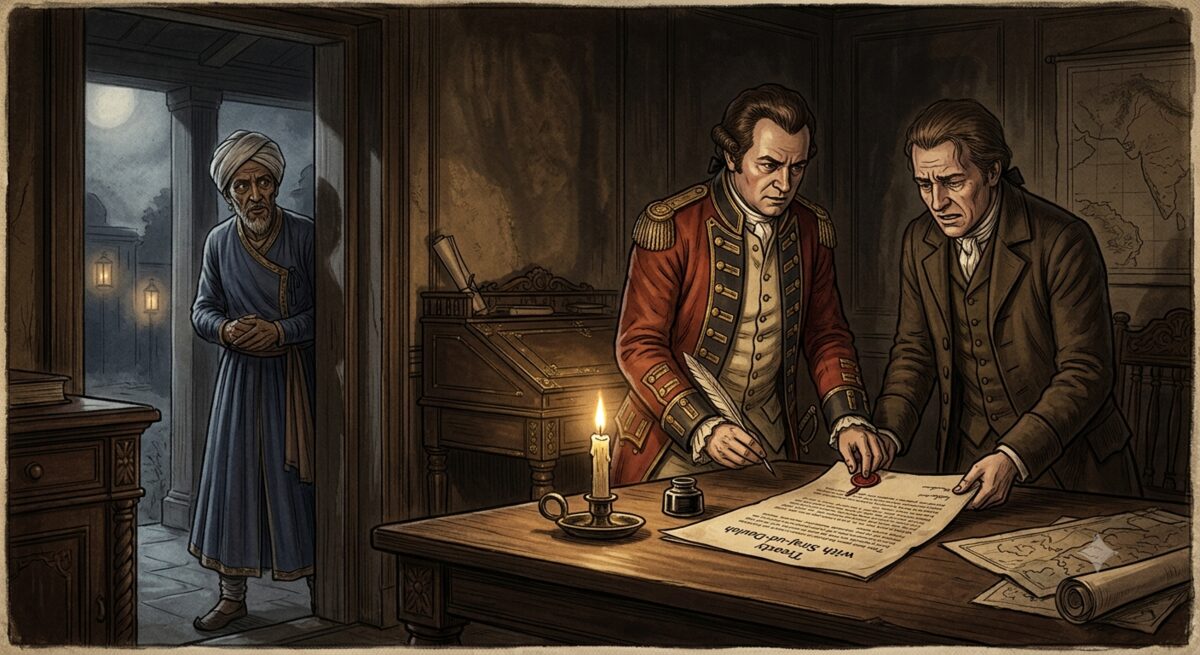
Before the battle even began, Robert Clive had already secured his outcome through a broken agreement, not a fought one. Clive’s secret pact with Mir Jafar — promising him the throne of Bengal in exchange for betraying Siraj-ud-Daulah on the battlefield — was itself sealed with a forged treaty document; Clive had banker Omichand’s copy of the agreement falsified because Omichand was demanding a separate payoff to stay silent. Plassey is arguably the single most consequential broken/forged agreement in Indian history: it opened the door to two centuries of East India Company and Crown rule.
The Doctrine of Lapse (1848–1856)
Governor-General Dalhousie’s policy directly overrode a long-established custom (and, in several cases, explicit treaty arrangements) that allowed Indian rulers without a natural heir to adopt a successor. By declaring adopted heirs invalid and annexing states like Satara, Jhansi, Nagpur, and eventually Awadh (annexed on separate grounds of “misgovernance,” itself a treaty violation), the British effectively tore up a century of subsidiary-alliance treaties they had signed with these very states. This mass breach of trust is widely cited by historians as one of the direct triggers of the 1857 Revolt.
Partition and the Instrument of Accession Disputes, 1947–48
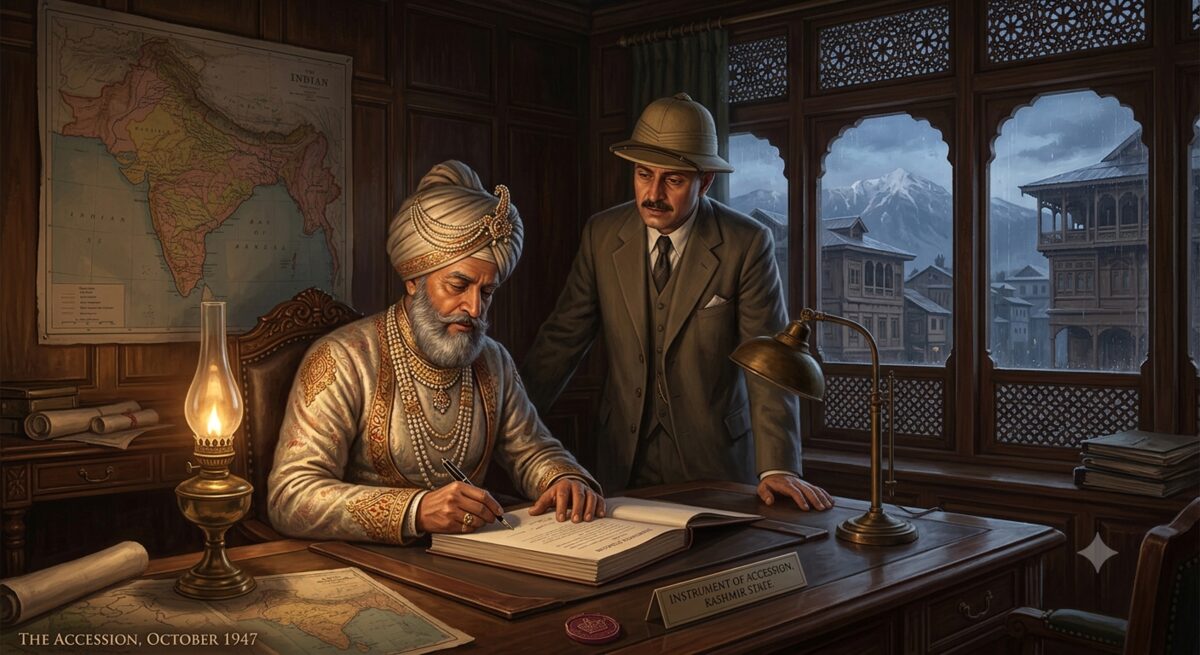
The transfer of power itself ran on paper — princely states were meant to freely sign an Instrument of Accession to either India or Pakistan. But the process was marked by contested and disputed signings: Junagadh’s Nawab acceded to Pakistan despite a Hindu-majority population, prompting Indian intervention and a later plebiscite; Hyderabad’s Nizam refused to accede at all until Operation Polo in September 1948; and Jammu & Kashmir’s accession, signed by Maharaja Hari Singh in October 1947 under invasion pressure from Pakistan-backed tribal raiders, remains the single most contested “agreement” in modern Indian history — its interpretation still shapes South Asian geopolitics eight decades later.
From Wax Seals to Aadhaar eSign: The Same Problem, a Faster Answer
Strip away the century and the medium, and every era in this story solved the identical problem with the best technology available to it: an Indus Valley seal pressed in clay, a Vedic oath before fire, Bali’s poured water, a Mughal emperor’s wax-and-tughra, a British revenue stamp glued onto vellum, and today, a government-recognised e-stamp certificate paired with Aadhaar-based eSign, verifiable in seconds from anywhere in the country. The instruments changed. The underlying human need — to make a promise survive the moment it was spoken, and to prove it later to someone who wasn’t there — never has.
That continuity is really the whole point of telling this story on a blog about stamping documents: what looks like paperwork is, if you zoom out far enough, one of the oldest and most human technologies there is.
Frequently Asked Questions
- What is the history of stamp duty in India?
- Stamp duty in India traces back to the East India Company's Regulation VI of 1797, which levied a fee on legal documents in Bengal, Bihar, Orissa, and Benares. The concept was consolidated under the Indian Stamp Act of 1899, enacted on 27 January 1899 and effective from 1 July 1899. That Act, amended many times since, remains the legal backbone of stamp duty in India today. The original idea of stamp duty was invented in the Netherlands in 1624 and adopted by England in 1694.
- When did e-stamping start in India?
- E-stamping was introduced in India by the Stock Holding Corporation of India Limited (SHCIL) as a secure, digital alternative to physical stamp paper. It was rolled out in phases across states starting in the mid-2000s after counterfeit stamp-paper scandals (most notably the Abdul Karim Telgi scam) exposed the vulnerability of the physical stamp-paper system. Today, e-stamp certificates are the preferred method of paying stamp duty in states like Karnataka, Maharashtra, and Delhi.
- What were the earliest forms of agreements in India?
- The earliest evidence of agreements in India comes from the Indus Valley Civilisation (c. 2600–1900 BCE), where Harappan merchants used carved steatite seals pressed into wet clay to mark goods for trade. In the Vedic period, agreements were oral, sealed by satya vachan (spoken truth) before witnesses and fire. By the time of Kautilya's Arthashastra (3rd century BCE), India had a formal system of written contracts, loan documents, and state-appointed officials for verification.
- Is the Indian Stamp Act 1899 still in force?
- Yes. The Indian Stamp Act of 1899 is still the primary central legislation governing stamp duty on instruments in India. Individual states have adopted it with local amendments, and some states (such as Maharashtra and Karnataka) have enacted their own stamp acts based on the 1899 framework. The Act applies to both physical stamp paper and modern e-stamp certificates issued by SHCIL.
- How does e-stamping work in Karnataka today?
- In Karnataka, e-stamp certificates are issued by SHCIL (Stock Holding Corporation of India Limited), authorised by the state government. Each certificate carries a unique identification number that can be verified online. For rental agreements, stamp duty is calculated at 0.5% of the total consideration (annual rent plus refundable deposit), subject to a minimum of Rs 500 for leases of 11 months or less. Platforms like DigitalPatra procure genuine SHCIL e-stamp paper and pair it with Aadhaar eSign for a fully digital, legally valid agreement.
Related Reading
Ready to create your agreement?
From clay seals to e-stamps, the need for a trustworthy agreement has never changed. Create yours today — legally valid, e-stamped, and Aadhaar eSigned in under 30 minutes.
Start Your Agreement →