E-Stamp vs Franking in Karnataka — Which Should You Use?
Updated July 2026 · 6 min read
If you are creating a rental agreement in Karnataka, you need to pay stamp duty. But how? The two most common methods today are e-stamping (through SHCIL) and franking (at a bank or authorised agent). This guide compares both methods head-to-head so you can make an informed choice.
There is also the older method of buying physical stamp paper from a licensed vendor, but this has been largely phased out in Karnataka. We will cover that briefly as well.
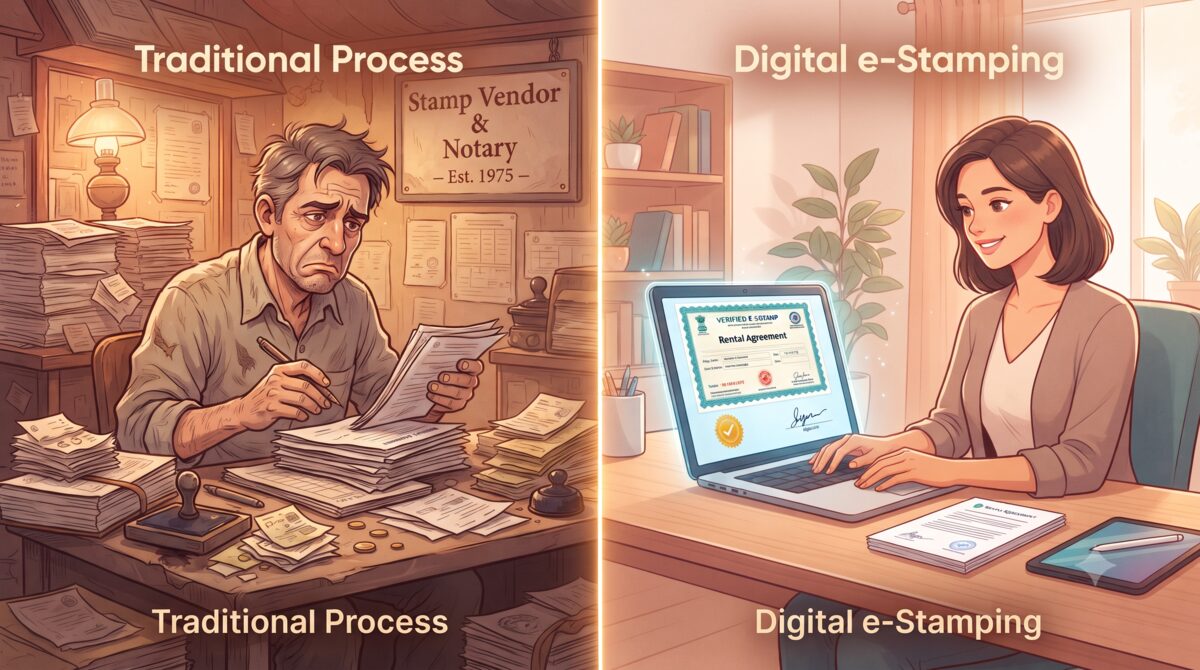
1. What Is E-Stamping?
E-stamping is a computer-based system for paying stamp duty, operated by the Stock Holding Corporation of India Limited (SHCIL) on behalf of state governments. When you pay stamp duty through the e-stamping system, you receive an e-stamp certificate — a printed document with a unique certificate number, a machine-readable barcode, and security features.
The key feature of an e-stamp certificate is its verifiability. Anyone can enter the certificate number on the SHCIL website and confirm that the stamp duty was genuinely paid, the denomination is correct, and the certificate has not been cancelled or used elsewhere.
Karnataka was one of the early adopters of the SHCIL e-stamping system, and it is now the primary method for paying stamp duty in the state. You can obtain e-stamp paper through authorised collection centres or through online platforms like DigitalPatra.
2. What Is Franking?
Franking is a process where a bank or an authorised agent stamps your document using a franking machine. The machine prints a mark on the paper indicating that stamp duty of a specified amount has been paid. You pay the stamp duty amount to the bank, plus a small service charge.
Franking was widely used before e-stamping became prevalent. Banks like SBI, HDFC, ICICI, and Axis Bank offer franking services at select branches. However, not all branches have franking machines, and you typically need to visit the branch in person during banking hours.
3. What About Physical Stamp Paper?
Traditional stamp paper — the green-tinted security paper sold by licensed stamp vendors — was the original method for paying stamp duty. However, it had significant security problems: counterfeit stamp paper was widespread, and there was no way to verify authenticity after purchase. The infamous Abdul Karim Telgi stamp paper scam (uncovered in 2003) exposed how deeply counterfeiting had penetrated the system.
Karnataka has largely moved away from physical stamp paper in favour of the SHCIL e-stamping system precisely because of these security concerns. While you may still find vendors selling physical stamp paper, e-stamp paper is the recommended and more secure option.
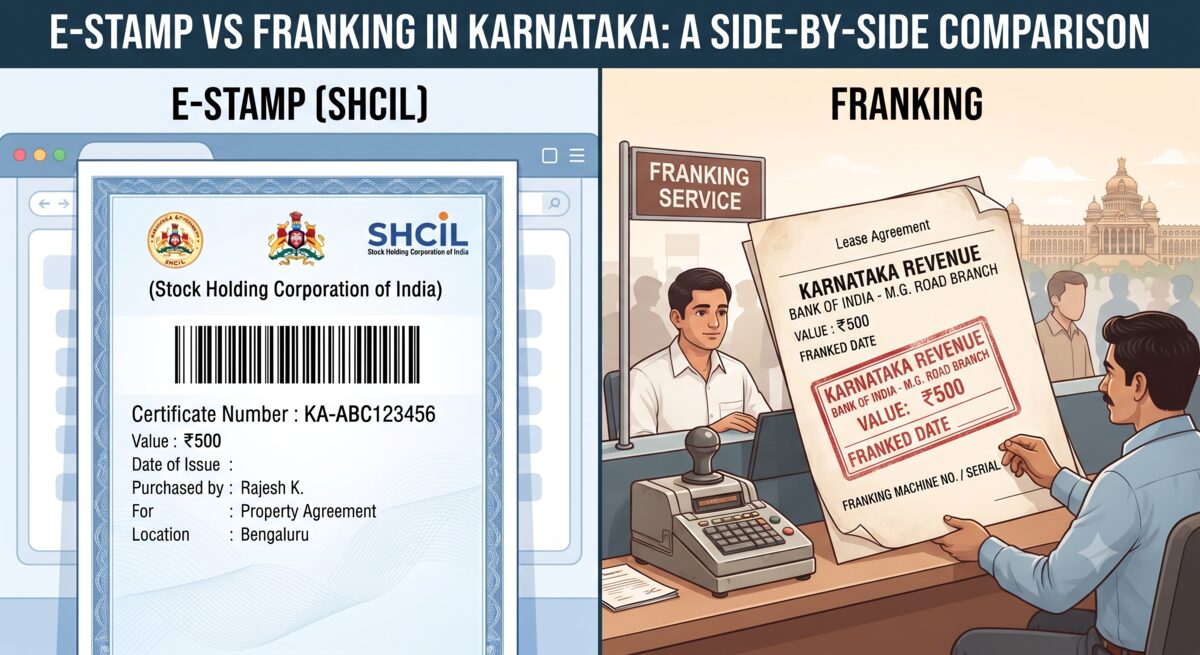
4. E-Stamp vs Franking: Head-to-Head Comparison
| Parameter | E-Stamp (SHCIL) | Franking | Physical Stamp Paper |
|---|---|---|---|
| Issuing authority | SHCIL (govt-authorised) | Banks / authorised agents | Licensed stamp vendors |
| Online verification | Yes (certificate number) | No | No |
| Availability | Online + collection centres | Select bank branches only | Vendor shops (limited) |
| Can obtain remotely | Yes | No (in-person) | No (in-person) |
| Denomination limit | No upper limit | Varies by bank (often capped) | Limited by available stock |
| Counterfeit risk | Negligible (verifiable) | Low | High |
| Processing time | Minutes (online) | 30-60 min at bank | Depends on vendor availability |
| Accepted by sub-registrar | Yes | Yes | Yes (where available) |
| Court admissibility | Full | Full | Full (if genuine) |
5. Why E-Stamp Paper Is the Better Choice
While both e-stamping and franking are legally valid methods of paying stamp duty, e-stamping offers clear practical advantages:
- Verifiability: The single biggest advantage. Anyone — a landlord, a tenant, a court, or a bank — can verify that your e-stamp is genuine by entering the certificate number on the SHCIL verification portal. Franked documents have no such verification mechanism.
- Convenience: E-stamp paper can be obtained online without visiting a bank branch. Through DigitalPatra, the e-stamp is procured automatically as part of the agreement creation process.
- No denomination constraints: Banks often cap franking amounts or charge higher fees for large denominations. SHCIL e-stamps have no such restrictions.
- Security: Each e-stamp certificate has multiple security features including a unique certificate number, barcode, and digital watermarking. Counterfeiting is practically impossible.
- Record keeping: SHCIL maintains a central database of all e-stamp certificates issued. Even if you lose your physical copy, the record of stamp duty payment exists in the system.

6. How to Verify an E-Stamp Certificate
Verifying an e-stamp certificate is straightforward:
- Locate the certificate number on your e-stamp paper. It is a unique alphanumeric code printed prominently on the certificate.
- Visit the SHCIL verification portal at
www.shcilestamp.comor use the DigitalPatra verification page. - Enter the certificate number and the state (Karnataka).
- The system will display the denomination, date of issue, and status of the e-stamp. If the details match your document, the stamp is genuine.
This verification step is particularly useful when you are a tenant moving into a new property and want to confirm that the landlord has used genuine stamp paper for the agreement.
7. Stamp Duty for Rental Agreements in Karnataka
Regardless of whether you use e-stamping or franking, the stamp duty amount is the same. For residential rental agreements in Karnataka:
- Rate: 0.5% of the total consideration (annual rent plus refundable security deposit).
- Minimum: Rs 500 for agreements of 11 months or less (as per Article 30 of the Karnataka Stamp Act).
For example, if your monthly rent is Rs 25,000 and your security deposit is Rs 1,00,000, the total consideration for an 11-month lease is Rs 3,75,000 (Rs 25,000 x 11 + Rs 1,00,000). Stamp duty at 0.5% would be Rs 1,875.
DigitalPatra's wizard calculates the exact stamp duty automatically based on your rent, deposit, and lease term.
8. The Verdict
For rental agreements in Karnataka in 2026, e-stamping is the clear winner. It is more secure, more convenient, and verifiable — three qualities that matter when your agreement needs to serve as evidence in a dispute. Franking is legally valid but offers none of the verification benefits that make e-stamping the modern standard.
If you are still using franked documents or physical stamp paper, it may be time to switch. With platforms like DigitalPatra, you can get a genuine SHCIL e-stamp online without visiting a bank or a stamp vendor.
Frequently Asked Questions
- What is the difference between e-stamp and franking?
- E-stamping is a digital stamp duty payment system managed by SHCIL where you receive a certificate with a unique, verifiable number. Franking is a physical process where a bank or authorised agent prints a stamp impression on your document using a franking machine. Both serve the same purpose of paying stamp duty, but e-stamps are verifiable online while franked impressions cannot be independently verified.
- Is e-stamp paper valid for rental agreements in Karnataka?
- Yes. E-stamp paper issued by SHCIL is fully valid for rental agreements in Karnataka. It is the government-authorised method for paying stamp duty electronically and is accepted by sub-registrar offices, courts, and all government authorities in the state.
- Can I verify an e-stamp certificate online?
- Yes. Every SHCIL e-stamp certificate carries a unique certificate number that can be verified online through the SHCIL website (www.shcilestamp.com) or through DigitalPatra's verification page. This is one of the key advantages of e-stamping over franking, which has no such online verification mechanism.
- Which method does the Kaveri sub-registrar office accept?
- The Kaveri Online sub-registrar offices in Karnataka accept both e-stamp paper and franked documents. However, e-stamp paper is preferred as it can be independently verified, reducing processing time and the risk of disputes over stamp duty payment.
- Is physical stamp paper still available in Karnataka?
- Traditional physical stamp paper (the green security paper sold by licensed vendors) has been largely phased out in Karnataka in favour of e-stamping. While some vendors may still have old stock, e-stamp paper from SHCIL is the current government-authorised method and is more secure against counterfeiting.
Related Reading
Ready to create your agreement?
Get a genuine SHCIL e-stamp online — no bank visit, no vendor, no queue. Your agreement is stamped, eSigned, and delivered in minutes.
Start Your Agreement →